International System of Units


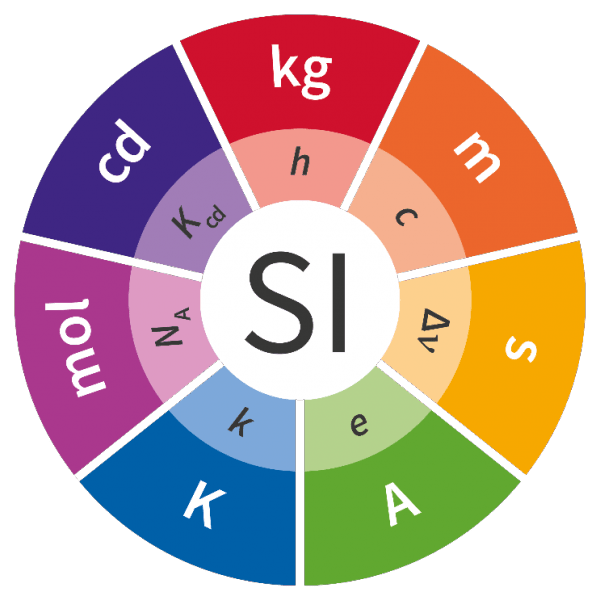
The International System of Units, also known as the SI system, is the internationally recognized standard system for measuring physical quantities. It is based on seven fundamental units, which are used to derive all other units of measurement. The seven fundamental units are:

Meter (m): The unit of length, defined as the distance traveled by light in a vacuum during a specific fraction of a second.

Kilogram (kg): The unit of mass, defined as the mass of a specific platinum-iridium alloy cylinder kept at the International Bureau of Weights and Measures in France.


Second (s): The unit of time, defined as the duration of 9,192,631,770 periods of the radiation corresponding to the transition between two hyperfine levels of the ground state of the cesium-133 atom.


Ampere (A): The unit of electric current, defined as the constant current that, if maintained in two parallel conductors of infinite length, of negligible circular cross-section, and placed one meter apart in vacuum, would produce between these conductors a force equal to 2 x 10^-7 newton per meter of length.


Kelvin (K): The unit of thermodynamic temperature, defined as the fraction 1/273.16 of the thermodynamic temperature of the triple point of water.


Mole (mol): The unit of amount of substance, defined as the amount of substance that contains as many elementary entities as there are atoms in 0.012 kilograms of carbon-12.


Candela (cd): The unit of luminous intensity, defined as the luminous intensity, in a given direction, of a source that emits monochromatic radiation of frequency 540 x 10^12 hertz and that has a radiant intensity in that direction of 1/683 watt per steradian.


The SI system also includes derived units, which are formed by combining the fundamental units using mathematical operations. For example, the unit of velocity is meters per second (m/s), which is derived from the fundamental units of length and time.

The SI system is used in many fields of science and engineering, including physics, chemistry, biology, and electronics. It provides a common standard for measuring physical quantities, which facilitates communication and comparison of data between different regions and disciplines.

The importance of signal conditioning

Signal conditioning is a crucial aspect of instrumentation as it prepares the raw signal from the sensor or transducer for measurement, processing, and analysis. Signal conditioning includes a set of processes and techniques that modify the raw signal to remove any noise, amplify the signal, and make it compatible with the data acquisition and control systems.

The importance of signal conditioning in instrumentation can be summarized as follows:

Noise reduction: The raw signal from a sensor or transducer can contain unwanted electrical noise that can interfere with accurate measurement. Signal conditioning techniques such as filtering, shielding, and grounding can effectively reduce the noise and improve the signal-to-noise ratio.

Amplification: The signal from a sensor or transducer may be too weak to be accurately measured or processed. Signal conditioning techniques such as amplification can increase the strength of the signal and improve its accuracy.

Compatibility: The raw signal from a sensor or transducer may not be compatible with the data acquisition and control systems used in the instrumentation. Signal conditioning can transform the signal to match the input requirements of the data acquisition and control systems, allowing for accurate measurement and control.

Calibration: Signal conditioning can also be used to calibrate the sensor or transducer and ensure that the measurement system is accurate and reliable.

In summary, signal conditioning plays a critical role in ensuring the accuracy, reliability, and compatibility of the measurement system in instrumentation. It prepares the raw signal from the sensor or transducer for measurement and analysis, removes unwanted noise, and improves the signal strength and compatibility with the data acquisition and control systems.


Measurement systems

In the context of instrumentation, measurement systems refer to the set of instruments, devices, and methods used to quantify physical quantities and measure them accurately. Measurement systems in instrumentation typically involve the following components:

Sensor or transducer: A device that converts the physical quantity being measured into an electrical signal that can be measured and processed by other instruments.

Signal conditioning circuitry: A set of circuits and components that amplify, filter, and process the electrical signal from the sensor or transducer to make it suitable for measurement.

Data acquisition system: A system that samples, digitizes, and stores the processed electrical signal from the signal conditioning circuitry.

Display and recording devices: Devices such as meters, oscilloscopes, and recorders that display or record the measured physical quantity.

Calibration and reference standards: A set of standards and procedures used to ensure the accuracy and reliability of the measurement system.


Measurement systems in instrumentation can be designed to measure a wide range of physical quantities, including temperature, pressure, flow, level, position, displacement, vibration, and many others. The selection of the appropriate measurement system depends on the specific application and the required level of accuracy and precision.


Physical quantities and units

Physical quantities are properties or attributes of a physical system that can be measured or quantified. Examples of physical quantities include length, mass, time, temperature, electric current, and luminous intensity, among others. Physical quantities can be classified as scalar quantities, which have only magnitude, or vector quantities, which have both magnitude and direction.

mechanical quantities

Mechanical quantities are physical quantities that relate to the behavior and motion of mechanical systems. Mechanical quantities can be classified as scalar or vector quantities, depending on whether they have only magnitude or both magnitude and direction.

thermal quantities

Thermal magnitudes are physical quantities that relate to the behavior of thermal systems, which include systems that involve heat transfer, thermodynamics, and thermal energy. 

magnetic quantities

Magnetic quantities are physical quantities that relate to the behavior of magnetic fields and their interactions with magnetic materials.

electrical quantities

Electrical quantities are physical quantities that relate to the behavior and properties of electrical systems and circuits.

optical quantities

Optical quantities are physical quantities that relate to the behavior and properties of light and its interactions with matter. 

chemical quantities

Chemical quantities are physical quantities that relate to the behavior and properties of chemical substances and reactions. 

Units, on the other hand, are standardized measures used to express the magnitude of physical quantities. Units enable scientists, engineers, and other users to communicate physical measurements in a standardized and unambiguous way. The International System of Units (SI) is the standard system of units used in most countries around the world. The SI defines seven base units, from which all other units are derived:

Meter (m) for length

Kilogram (kg) for mass

Second (s) for time

Ampere (A) for electric current

Kelvin (K) for temperature

Mole (mol) for amount of substance

Candela (cd) for luminous intensity

In addition to the base units, there are many derived units that are used to express combinations of base units. For example, the unit of speed is meters per second (m/s), which is a combination of the base units of length and time. The unit of power is watts (W), which is a combination of the base units of energy and time. Overall, physical quantities and units are essential concepts in science, engineering, and many other fields. By using standardized units to express physical measurements, we can communicate and compare measurements made by different people using different instruments, and make meaningful predictions and analyses based on these measurements.


Variables and signals

 In the context of engineering and technology, variables and signals are two related concepts that are used to describe the behavior of physical systems.

A variable is a quantity or property of a physical system that can take on different values or states. Examples of variables include temperature, pressure, flow rate, voltage, and current. Variables can be measured using sensors or measurement tools, and their values can be manipulated or controlled using control systems or feedback loops... 

A signal, on the other hand, is a time-varying quantity that represents the behavior of a physical system over time. Signals can be used to represent variables, as well as other properties of a system, such as its frequency content or spatial distribution. Signals can be measured using sensors or measurement tools, and they can be processed or analyzed using signal processing techniques. Signals and variables are related in that a signal can be used to represent the behavior of a variable over time. For example, a temperature sensor might produce a signal that varies over time, with the amplitude of the signal corresponding to the temperature at a particular moment in time. Similarly, a voltage signal might represent the voltage across a circuit element over time.

In engineering and technology, the analysis and manipulation of signals and variables are essential for understanding and controlling physical systems. Signals can be used to diagnose problems, optimize performance, or provide feedback for control systems. Variables can be used to define system behavior and specify requirements for system design and operation. Overall, signals and variables provide a powerful set of tools for understanding and controlling the behavior of physical systems.

what mean the variables and signals in electronic instrumentation?

In electronic instrumentation, variables and signals refer to the quantities and waveforms that are measured and processed by electronic instruments.

Variables in electronic instrumentation refer to physical quantities such as voltage, current, resistance, temperature, pressure, and flow rate, among others. These variables are measured using sensors or transducers that convert physical properties into electrical signals that can be processed and analyzed by electronic instruments. Signals in electronic instrumentation refer to electrical waveforms that represent the behavior of electronic circuits or systems. These signals can be generated by electronic instruments or measured using sensors or probes. Electronic signals can take many different forms, including analog signals, digital signals, and mixed signals.

In electronic instrumentation, signals are often processed and analyzed using signal processing techniques, such as filtering, amplification, modulation, demodulation, and waveform analysis. These techniques can be used to extract information from the signals, remove unwanted noise, or prepare the signals for further processing or analysis. Overall, in electronic instrumentation, variables and signals are the fundamental quantities and waveforms that are measured and analyzed to obtain information about physical systems. By measuring and analyzing these quantities and waveforms, electronic instruments can provide valuable insights into the behavior of electronic circuits and systems, and help to improve their performance and reliability.


Measurement tools

 Measurement tools are devices or instruments used to quantify or determine the physical properties of an object or system. These tools are used to obtain data about various parameters such as length, mass, temperature, pressure, electrical properties, and other physical quantities.


Measurement tools may be analog or digital, depending on the type of data they are designed to measure. Analog tools typically rely on physical properties, such as the position of a needle on a gauge or the expansion of a liquid in a thermometer, to provide a reading. Digital tools, on the other hand, convert physical properties into digital signals, which are then displayed on a screen or readout.

These are used in many different fields, including engineering, science, medicine, and manufacturing. Accurate and precise measurement is critical in these fields to ensure that products or systems meet the required specifications and to identify any problems or defects that may arise during production or operation. Overall, measurement tools are an important part of many industries and applications, providing valuable data that is used for decision-making, quality control, and safety. The selection and use of appropriate measurement tools, as well as the proper calibration and maintenance of these tools, are essential for ensuring accurate and reliable data.


What is instrumentation?

 Instrumentation refers to the design, development, and use of instruments, devices, and systems for measuring, monitoring, and controlling various parameters and variables in a given process or system. In the context of engineering and technology, instrumentation refers to the tools and techniques used to obtain data about physical systems, and to use that data to control or optimize the systems. Instrumentation can involve physical measurement devices like sensors, as well as software tools for data processing, analysis, and visualization.


The scope of instrumentation is quite broad and can encompass a variety of fields and applications. For example, in the field of mechanical engineering, instrumentation may be used to monitor the temperature, pressure, and flow rate of fluids in a machine or manufacturing process. In chemical engineering, instrumentation may be used to monitor chemical reactions and optimize the production process. In electronics, instrumentation may be used to measure the electrical properties of components or circuits... Overall, instrumentation is an essential part of modern technology and engineering, providing engineers and scientists with the tools necessary to measure, monitor, and control physical systems and processes with a high degree of precision and accuracy.


Instrumentation Amplifier

Instrumentation Amplifier: Enhancing the Power of Wheatstone Bridge Measurements Introduction: In the realm of electrical engineering and pr...